An Industrial Insight into Physical Modification, Enzymatic Hydrolysis, and Microbe Utilization
Extruded soybean meal represents a physical transformation milestone in agricultural chemistry. By utilizing HTST (High-Temperature Short-Time) extrusion technology, raw soybean structures are denatured under intense pressure (25–40 bar) and temperature (120°C–150°C).
This process breaks down cell walls, inactivates anti-nutritional elements like urease and trypsin inhibitors, and dramatically increases water solubility and protein digestibility index (PDI) for bio-industries.
Raw soybeans contain high levels of biologically active anti-nutrients (ANFs) like lectins, goitrogens, oligosaccharides (raffinose and stachyose), and allergen proteins (glycinin and beta-conglycinin) that inhibit enzyme activity.
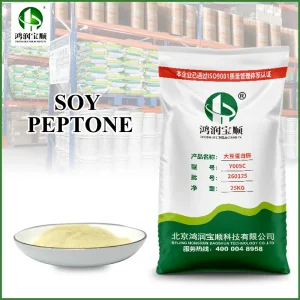
Through our optimized factory thermal-mechanical extrusion profile, these ANFs are denatured, yielding a highly bio-available raw input ready for direct fermentation or deep enzymatic hydrolysis into soy peptones.
When used as a fermentation substrate, the nitrogen profile of extruded soybean meal is far superior to standard oil-extraction meal. Structural protein polymers are partially uncoiled, allowing microbial extracellular peptidases easy access to peptide bonds.
This speeds up cell-doubling times, optimizes biomass growth curves, and increases secondary metabolite production in industrial biotechnology.
Established Year
Production Base Area
Industrial Warehouse Capacity
Expert Production Staff
Adapting to Regulatory, Supply Chain, and Non-GMO Market Shifts
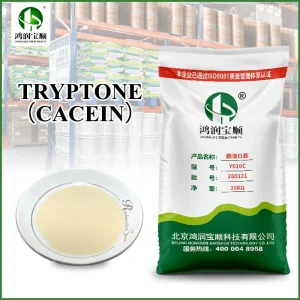
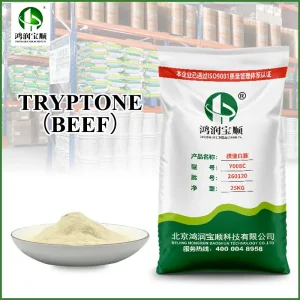
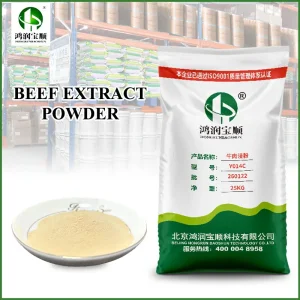
Global pharmaceutical, diagnostic, and industrial enzyme producers are rapidly pivoting away from animal-derived peptones (like beef extract or casein digests) due to biosafety concerns regarding Transmissible Spongiform Encephalopathies (TSE) and Bovine Spongiform Encephalopathy (BSE). Our high-grade extruded soybean meal and plant-derived soy peptone serve as the premier organic nitrogen substitute, offering complete viral safety margins and robust growth kinetics without animal-associated regulatory risks.
With production facilities expanding from the science clusters of Beijing to the high-capacity Qili Industrial Park in Langzhong, Sichuan, Beijing Hongrun Baoshun Technology Co., Ltd. operates a highly resilient supply chain. Our local warehousing capacity exceeding 20,000 square meters allows us to hedge against global maritime delays, offering stable, continuous raw material supply to clients in North America, Western Europe, Southeast Asia, and South America.
Different industrial microorganisms—ranging from simple bacteria like E. coli and Bacillus species to complex filamentous fungi and yeasts—prefer distinct molecular weight distributions of nitrogen sources. We offer tailored enzymatic digestion processing. We customize parameters to control the ratio of free amino acids to short-chain peptides (oligopeptides) and long-chain polypeptides, ensuring optimized substrate uptake speeds in our client's bioreactors.
High pressure/temperature parameters rupture fiber matrices and denature anti-nutrients.
Controlled proteases hydrolyze complex soy proteins into targeted molecular weight profiles.
Ultrafiltration and multi-stage purification steps remove insoluble fiber and ash elements.
Controlled vacuum spray drying creates highly soluble, non-hygroscopic, dust-free powders.
Optimizing Plant-Based Substrates Across Industrial Vectors
Whether formulated as dehydrated media powders or liquid concentrates, our soy-derived compounds supply essential growth factors, vitamins (especially B-complex), and digestible nitrogen, providing a critical growth platform for challenging organisms like fastidious anaerobes and GMO production strains.
For lactic acid bacteria (LAB) such as Lactobacillus and Bifidobacterium used in human health and food preservation, animal-free substrates are mandatory. Our products provide the rich nucleotide and peptide building blocks required for rapid acidification and high CFU density yields.
Beyond the sterile bioreactor, our agricultural-grade extruded soybean meal hydrolysates provide highly active organic nitrogen and free L-amino acids (like glutamic acid, aspartic acid, and proline) that promote root growth, improve soil microbiology, and trigger plant defense mechanisms.
Our production structure works in close collaboration with our five specialised subsidiaries to deliver tailored fermentation outcomes:
Setting the Industry Standard for Batch Consistency and Global Certifications
Certified as both a National "High-Tech Enterprise" and a "Zhongguancun High-Tech Enterprise" since 2008, affirming our dedication to scientific innovation and process optimization.
Operating independent animal-derived and plant-derived production facilities. This strictly eliminates cross-contamination risks and meets rigorous kosher and allergen-control requirements.
Adhering to strict international standards under our validated ISO 9001:2015 Quality Management System and certified Halal by MUI, opening global markets for our clients.
Predicting the Next Phase of Sustainable Nitrogen Substrates
As synthetic biology (SynBio) advances to scale up alternative proteins, cultured meat, and biological APIs, media formulation costs are the primary bottleneck. Our engineering roadmap focuses on optimizing extruded soybean residues into highly refined peptide mixtures, lowering manufacturing media costs by up to 40% compared to traditional synthetic options.
Soybean extracts naturally contain plant pigments and characteristic volatiles (such as hexanal). We are upgrading our physical filtration systems to incorporate advanced activated carbon and polymeric resin columns. This produces ultra-clear, low-odor, light-colored media solutions that simplify downstream purification (DSP) for therapeutic proteins.
In step with global carbon reduction targets, our Sichuan production base utilizes renewable biomass fuel profiles and closed-loop heat recapture from our high-temperature extrusion systems. We minimize product life cycle assessments (LCAs), helping global buyers reach their Scope 3 emission targets.
Industrial Procurement & Technical Specifications Q&A
 Hongrun Baoshun